
Albany Resident Lookup Records
An Albany resident lookup works best when each source has a defined job. The county property record can establish a recorded owner, parcel number, situs address, and tax mailing destination. It cannot establish every occupant. The state voter form can confirm an individual registration only when the required identity and address inputs are known. Court results identify a party and case, not a present address. Vital records are held through restricted local or state channels. Treat each result as one piece of a record trail, then compare it with a second source that uses a different attribute.
| Record | What It Confirms | Where | Access |
|---|---|---|---|
| Property roll | Recorded owner, parcel, situs and tax mailing address | Albany County PROS | Free public search; owner is not necessarily an occupant |
| Voter registration | Individual registration and election information | NYS Voter Lookup | Required identifying inputs; protected records are absent |
| Court docket | Party role, court, case number, status and appearances | NYS eCourts | Not every file or detail is online |
| Vital record | Eligible birth, death, marriage, or relationship evidence | City Vital Statistics or NYS DOH | Closed records and eligibility rules apply |
| Directory or yearbook | Historical address, occupation, school, or move clue | Albany Public Library | Print, film, digital, or staff-assisted access |
| Entity or license filing | Public affiliation or credential details | NYS entity search | Search result is not proof of a personal residence |
Use an address-first route when a parcel is known. Use the individual voter form only when its requested name, date-of-birth, county, and address details are already available. For a person from an earlier period, Albany Public Library directories and the Hall of Records usually provide the first address trail. A court or business filing may help separate same-name people, but its party role must be read before it becomes an identity clue.
Starting an Albany Resident Lookup
Keep a simple log with the spelling used, source, date, municipality, and the fact the source actually supports. Albany County PROS accepts an owner name, street address, tax-map number or SBL, which means Section-Block-Lot, the parcel identifier found on a tax bill or map. Its owner search can match a prior owner as well as a current one. The voter tool is much narrower: it is an individual registration and poll-site service, not a broad people list.
- Normalize the name. Retain a middle initial, maiden or married form, spacing variation, and any known spelling difference instead of merging them at once.
- Where an address is known, search PROS and record the municipality, SBL, situs, owner name, and separate tax mailing address. A mailing address can be a post office box, office, representative, or another property.
- Use one independent attribute to test a match. An SBL, book and page, municipality, recorded party role, age or relationship from an eligible record is stronger than a name alone.
- Use the relevant court, genealogy, or archive channel to resolve the remaining question. Preserve the source year, because a historical address does not establish a current one.
That sequence is particularly important for common Albany names. A deed may name an executor, lender, trustee, or attorney instead of a person who lived at the location. A court caption may name a litigant or representative. The fact that a name appears is a lead, not a conclusion. Note: PROS distinguishes the parcel location from the address used for tax correspondence, so those fields should never be treated as interchangeable.
Checking Albany Resident Court Records
New York's eCourts hub provides different routes for WebCivil Supreme, WebCivil Local, WebCriminal, WebFamily, calendars, eTrack, and related products. Choose the court product first, then use the party name or a case, index, file, or docket number where the route allows it. County, court, or location choices vary by product, so select Albany County or the relevant Albany court rather than assuming a statewide name hit belongs locally. The interface also supports product-specific status, date, and case-type filtering.
| eCourts field | Albany use |
|---|---|
| Court product | Select the civil, criminal, family, calendar, or tracking route before searching. |
| Party name | Use first and last name variants; matching names need independent confirmation. |
| Case, index, file, or docket number | Use the number when known; partial or exact behavior depends on the product. |
| County, court, or location | Choose the Albany County, Albany City Court, Supreme, County, or Family option offered by that route. |
| Status, type, or date | Apply only product-specific filters that fit the known event. |
| Appearances | Use Appearance Date or Show All Appearances after a result to review listed events. |
An eCourts result can show court and county or location, an index or docket number, caption, case type, filing or commencement date, status, parties and their roles, and appearance or event history. For e-filed civil cases, the NYSCEF public case search is the public route to a docket and, when public and unsealed, its document list. Juvenile, adoption, sealed, expunged, and many protected family matters are not general web results. Court staff, not the web administrator, handle a data-entry correction.
When the web result stops, move from eCourts to the clerk or courthouse terminal. The Albany County Clerk holds County Court and Supreme Court records and lists a $5 search for two consecutive years. Its schedule lists a $0.25 per-page copy charge and separate certification charges. Mail requests need enough identifying information, a self-addressed stamped envelope, and a check or money order. Call ahead before relying on a terminal or requesting an older paper file.
Albany Resident Lookup Vital Routes
Vital records require the correct custodian and an eligible request. City of Albany Vital Statistics holds city birth and death events beginning September 1, 1870, while city marriage material is held by the City Clerk. The city does not treat birth or death records as public or FOIL records. For genealogy, its stated periods are 75 years for a birth when the person is known deceased, 50 years for a death, and 50 years for a marriage when both spouses are deceased. Proof of direct lineage can support a waiver of those periods.
The City of Albany genealogy service explains the local request route and its evidence requirements.
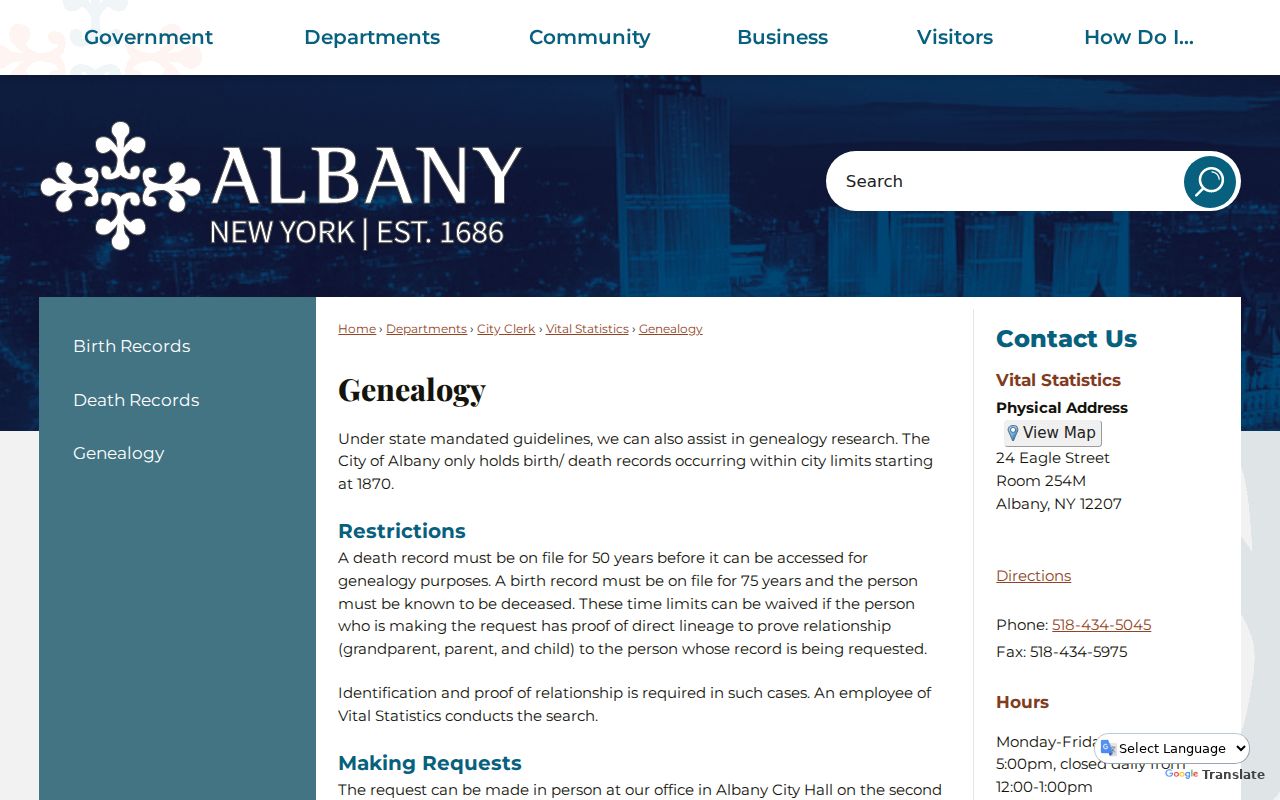
Use the city form and instructions to match the record type, period, proof, identification, and payment method before requesting a copy. The image is a route to the custodian, not a public index of residents.
For New York State records outside New York City, the NYS Department of Health genealogy service applies the same 75, 50, and 50-year framework, including the deceased-person and both-spouses conditions. Albany city events before January 1, 1914 belong with the local city route rather than the state route. State certified mail copies and genealogy copies have different fees and processing paths. City genealogy requests may be made in person or by mail; state requests use the DOH mail process. An eligible certified copy is not the same thing as a genealogy copy.
Note: A death notice, directory listing, or obituary may supply a date or relationship lead, but none replaces the eligibility rules for a vital-record copy.
Verifying an Albany Resident Record
Verification means testing a proposed identity against facts that do not all come from the same record. Start by anchoring a name to an address or parcel, then compare the municipality, date, party role, relationship, or historical address to a second source. A court index can separate two people with the same name through case placement and role. A property record can link a recorded owner to a parcel. An eligible genealogy record can confirm a family relationship or event, but it should be requested only through the applicable city or state channel.
- Record the address, SBL or book and page from PROS, GIS, or a deed, keeping situs and mailing fields separate.
- Run the name and spelling variants in eCourts. Compare the court, location, party role, case type, and status rather than relying on the caption alone.
- Use an eligible vital, probate, directory, or voter source to test an independent attribute such as relationship, year, ward, or municipality.
- Request a copy from the office that holds it only when the record and eligibility rules support that request. Correct an indexing problem with that custodian.
- Docket or index number
- A docket or index number identifies a court matter. It helps find a case file, but it does not prove that every named party lives in Albany.
- Index and image
- An index is a searchable listing of basic record details. An image is the scan of the underlying filing or document, which may have a separate access route.
- Certified copy
- A certified copy is a custodian-issued copy bearing the office's certification. Eligibility, fees, and request methods vary by record type.
Albany Resident Lookup Adoption Records
Sealed adoption material is not a source for ordinary name searching. New York's Adoption Information Registry is the authorized official route for eligible adult adoptees, birth parents, and eligible siblings. It can provide non-identifying information under the program rules. Identifying names or addresses depend on the required registrations and consent. The registry cannot search for a missing registrant, and it is not a shortcut around sealed court records.
Use the registry instructions for signed or notarized applications and the documentation required from an adoptee or sibling. The registry itself has no fee, though an agency may charge a permitted fee. This consent-based route protects people who have not chosen contact. It also gives family members a lawful option when a birth-parent question cannot be answered through a public index.
Albany Resident Lookup Fallbacks
When an online search is incomplete, use the channel tied to the record's age and custodian. For court work, begin with eCourts, then ask the court or County Clerk about a terminal, copy, or archival file. For city and state vital records, use the City Vital or DOH mail and in-person process, not a FOIL request. A FOIL request under New York Public Officers Law Article 6 can reasonably describe an existing non-exempt agency record, but it does not open a vital record made confidential by statute.
For older Albany names, the Hall of Records genealogy resources and Albany Public Library Local History Room offer the archival path. Hall holdings include historical voter material, naturalizations, old deed indexes, maps, and census sources; the library has directories, newspapers, obituaries, and yearbooks. A historical directory address needs a source year and should not be presented as a current location. The historical shelf is treated in more detail in the Albany City Directory.
Albany Resident Lookup Privacy Boundaries
An Albany resident lookup ends where confidentiality begins. New York's Address Confidentiality Program allows eligible participants to use a substitute Albany mailing address, while their actual location remains protected except in narrow statutory circumstances. Confidential voter registration under Election Law §5-508 is kept separate and unavailable for public inspection for four years. Voter records also withhold sensitive identification details under Election Law §3-220. A missing voter result may be an intentional safety protection, not a search failure.
Parcel data does not identify all occupants. It does not open utility, delivery, or DMV address records. Court files can be sealed or otherwise restricted, and a no-result search cannot prove that an event never occurred. Commercial compilation tools may be stale or combine same-name records, so compare a claimed fact with the office that created it. The NYS Address Confidentiality Program is the official source for its eligibility and participation rules.
Lawful use. Use Albany records for personal, civic, family-history, safety, or correction purposes. Do not use a result to stalk, harass, intimidate, or harm any person.