
Finding Albany Residents in Records
No single roll identifies every Albany household. The useful starting point depends on what is already known. A street address fits the county property roll. A recorded owner fits the deed index. A person who is already known to be registered can be checked through the state voter service with the required identity details. For an older household, Albany directories, maps, voter books, and census volumes are more useful than a modern search form.
Keep each result in its own lane. A tax mailing address is where notices go, not always where an owner lives. A deed shows recorded parties and a legal description. A directory places a name at an address in the volume year. Comparing two independent records is more dependable than relying on one matching name.
- Search the Albany County PROS property search by owner, address, SBL, or Street Finder when a parcel is the starting point.
- Record the municipality, situs address, mailing address, and SBL or print key separately.
- Check a recorded party in the County Clerk online records search, then read the deed description before connecting it to the parcel.
- For a current voter question, use the NYS voter lookup with the requested name, date of birth, county, and address.
- Move to the library or Hall of Records for historical households, old street names, and offline material.
Note: A match is strongest when its spelling, municipality, address, and record date all agree.
Albany Resident Records Offices
Albany County keeps its current land and court trail in several places. The County Clerk is the land-record recorder and court-record keeper. The Real Property Tax Service Agency maintains county tax maps while local assessing units create their rolls. The Board of Elections administers county election records, and the state voter lookup is an individual service rather than a full public household list. The Hall of Records is the archival counterpart for older deeds, assessments, voters, maps, and related city and county records.
Albany County Clerk
County Court House, Room 128
16 Eagle Street, Albany, NY 12207
(518) 487-5100
Real Property Tax Service Agency
112 State Street, Room 1103
Albany, NY 12207
(518) 487-5290
Albany County Hall of Records
95 Tivoli Street
Albany, NY 12207
(518) 436-3663
Albany Residents Through PROS
Albany County PROS is the main current parcel doorway. Its quick form accepts Street Address, Tax Map number or SBL, Owner Name, Street Finder, and Municipality. Street Finder is a dropdown of public roads, and an owner search can match current or prior owners. The documented exact-last-name method adds an equals sign before the surname. Address searching is broad, so a short term can return more than one road or suffix.
The inspected PROS quick-search screen shows the county fields used for the first parcel check.
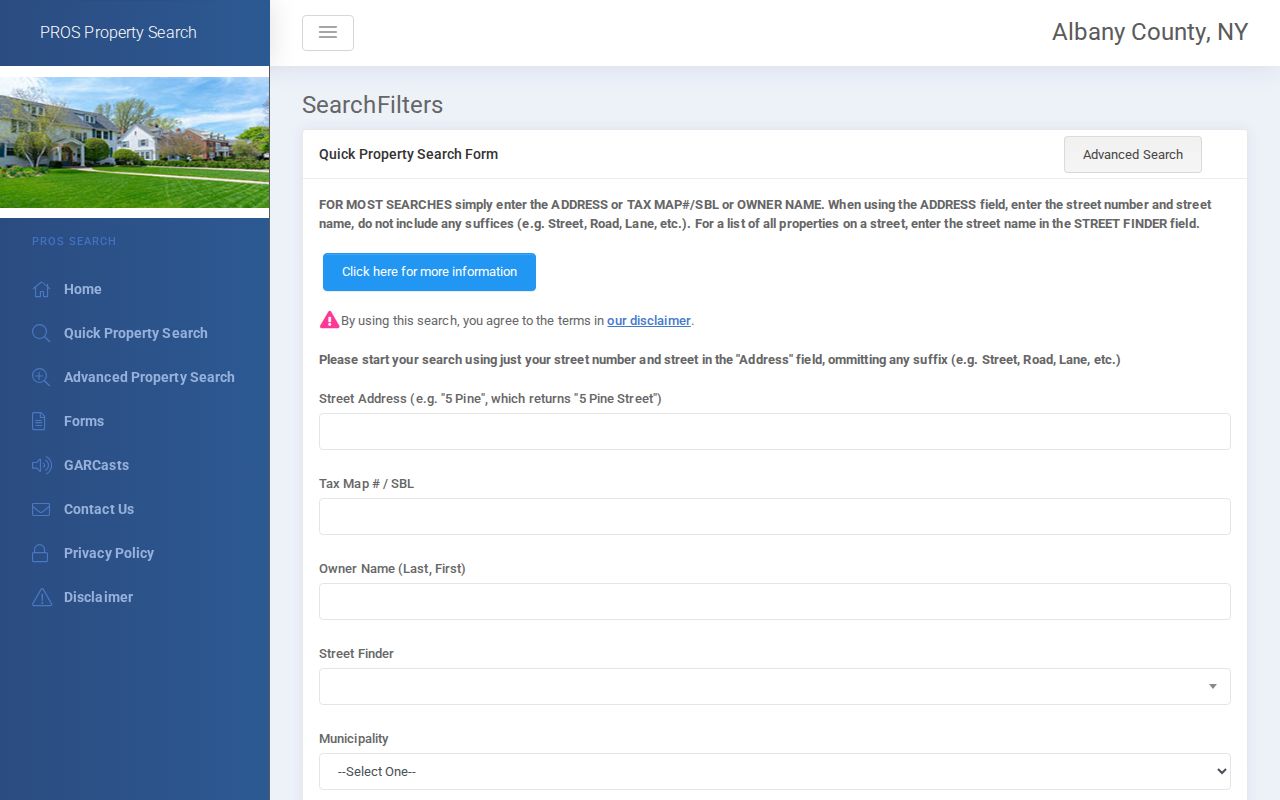
Use the result to distinguish the parcel location from the address used for tax correspondence, then preserve the SBL for a later map or deed search.
| PROS field | How it narrows an Albany record |
|---|---|
| Street Address | Use a number and street, without a suffix, for the documented address route. |
| Tax Map # / SBL | Stabilizes a parcel when a street name or number is ambiguous. |
| Owner Name | Finds current or prior-owner matches; exact surname syntax is documented. |
| Street Finder / Municipality | Returns addresses on a selected county road and separates local jurisdictions. |
Albany Voter Record Limits
The New York voter service requires last name, first name, date of birth, county, and address for its individual lookup. It can confirm election registration and poll-site information for the supplied person. It is not a statewide browse of everyone on a street. The state Board of Elections handles a fuller record request through its FOIL route, with an election-purpose statement and statutory limits.
The NYS voter lookup form shows the name, date, county, and address inputs that make this a verification tool rather than an open residents directory.
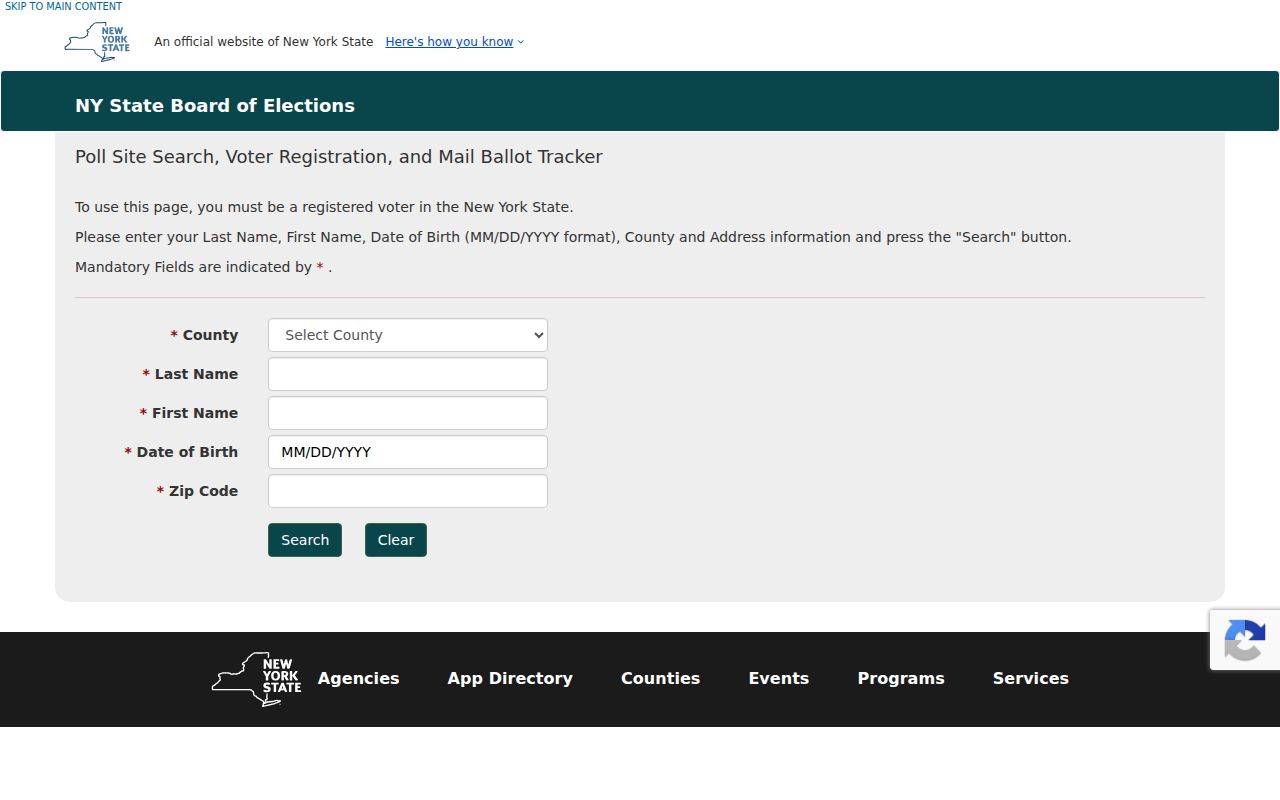
Election Law §3-220 excludes driver-license, non-driver ID, Social Security, and facsimile numbers from public voter records. Election Law §3-103(5) limits statewide registration information to election purposes, and confidential registrations are not available for ordinary inspection.
Current Albany Resident Directory Sources
Each current Albany directory source answers a narrower question than the phrase “who lives here” suggests. Property data is best for a recorded owner and parcel. The voter service is specific to an already identified registrant. A deed index names parties to a transaction. City and neighborhood resources can point to public offices or civic contacts, but they are not household rosters.
| Albany source | What the record identifies | Custodian | Access channel |
|---|---|---|---|
| PROS / assessment roll | Owner, parcel, situs, tax mailing address, SBL | Local assessor and county tax service | Free web search and local rolls |
| NYS voter lookup | Individual registration and poll-site information | State and county elections offices | Online individual service; supervised/FOIL channels for records |
| County Clerk index | Deed, mortgage, lien, judgment, DBA, or UCC party | Albany County Clerk | Online service, search room, mail request |
| City staff directory | Municipal staff names, titles, and public contacts | City of Albany | Free public directory |
| CANA contact table | Neighborhood association contact route | Local civic associations | Public contacts, not member lists |
Use the source whose limits match the question. A property record can show a recorded owner but cannot stand in for a current household list. A city staff directory identifies public employees, not private residents. CANA publishes neighborhood-association contacts rather than member names. The state voter form confirms an individual registration only when the required information is supplied. This separation prevents a public record from being stretched beyond what it actually says.
When the goal is a whole road rather than one person, the address-first process belongs on the Albany street directory. It keeps the parcel, deed, and historical address layers separate.
Albany Deed and Court Trails
The County Clerk's online service covers deeds, mortgages, judgments, liens, DBAs, lis pendens, UCCs, and warrants. Deed and mortgage images are stated online from 1980, while the Clerk's holdings reach much farther back. A vendor help segment identifies index information for deeds from October 20, 1908 through January 4, 1980. Check the record type and displayed range before assuming an image is available.
For a name tied to a case, use the NYS eCourts hub to select the appropriate civil, criminal, family, or calendar route. A court party name is not proof of residence or responsibility. Court files can be sealed or limited, and the clerk is the correction route for an error. County Clerk search-room and mail channels remain useful when an older document is not online.
County and Supreme Court records are held through the Clerk, while Surrogate's Court handles wills, letters of administration, estates, guardianships, and probate filings. An estate file may identify a decedent, fiduciary, or heir, but the role must be read before using the name as an address clue. For federal cases, PACER provides the Northern District route and requires an account. Public courthouse terminals and the clerk can provide a practical fallback when a web summary lacks a file detail.
Note: The Clerk states a $5 search fee for a pre-1980 mail search, while a self-search at the office avoids that search fee.
Albany Vital Record Routes
Birth, death, marriage, and divorce records require a different path. City of Albany Vital Statistics keeps city birth and death records from September 1, 1870. The New York State Department of Health handles statewide outside-NYC material, but Albany city events before January 1, 1914 are a local exception. Neither channel is an unrestricted public name index.
New York's genealogy service lists the age and eligibility rules for historical requests.
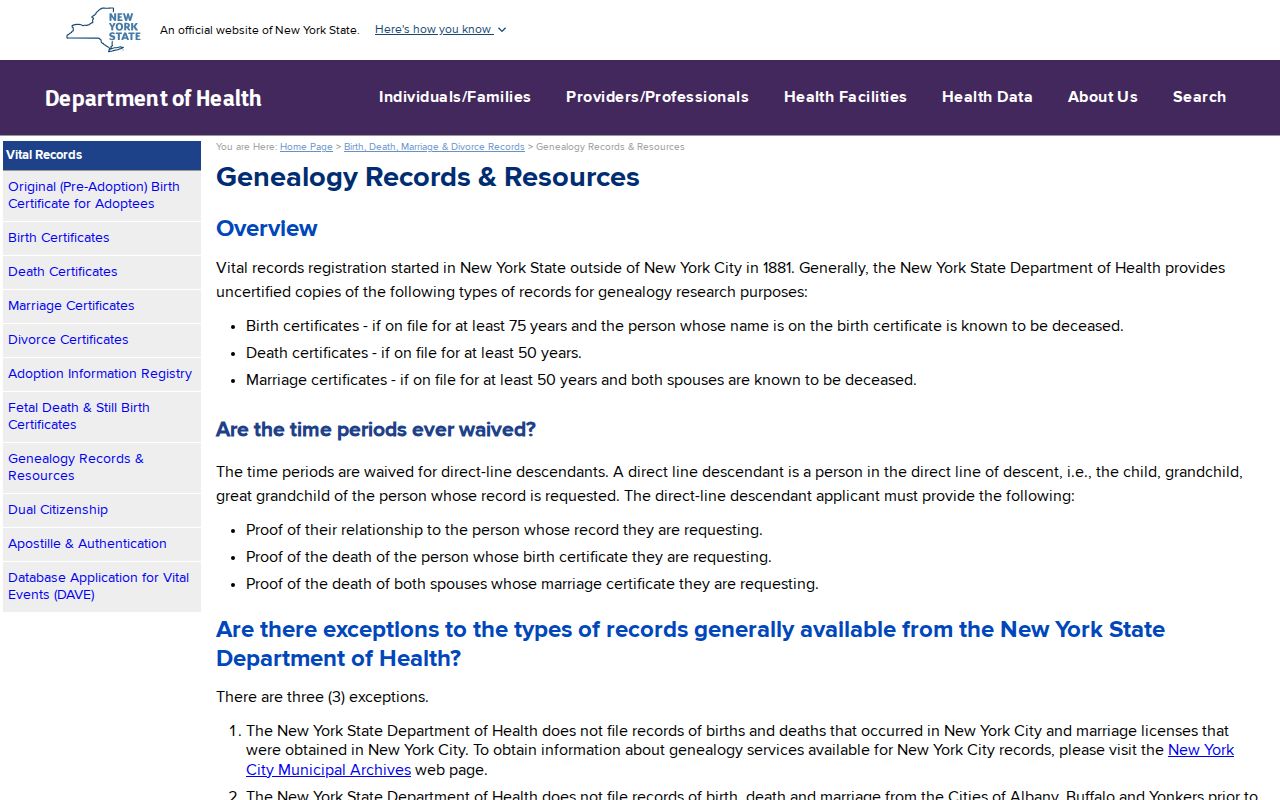
For genealogy, a birth is generally available after 75 years with death established, a death after 50 years, and a marriage after 50 years when both spouses are deceased. Direct-line proof can waive those periods. The local City of Albany route and the state route have different handling times and payments, so use the correct custodian first.
Albany Directory Research Terms
Historical Albany research has a few terms worth separating before a name search. They help explain why a modern parcel result, an old entry, and a deed can all be true without saying the same thing.
- Roll
- An assessment or voter list made for a particular public purpose and period.
- Index
- A finding tool that points to a deed, case, book, page, or other underlying record.
- Criss-cross directory
- A reverse street or house guide that starts with an address and lists occupants when the volume includes one.
- Parcel
- A mapped unit of property identified through an SBL, print key, or similar tax-map identifier.
Albany's older records also use ward names and former street names. Preserve the spelling and date shown in the source instead of forcing a historical entry into a modern address format.
Albany Library Directory Collections
The Albany Public Library Pruyn Collection is the strongest local shelf for historical residents directory work. Its nearly complete Albany City Directory run begins in 1813 and continues to the present. The Local History Room also holds newspapers, maps, yearbooks, clippings, photographs, pamphlets, and other material that can add a date or name variation to a directory entry. The room is at the Washington Avenue Branch and uses appointment access, so confirm current hours before a visit.
The Local History Room page describes the Pruyn Collection and the research material available at the library.
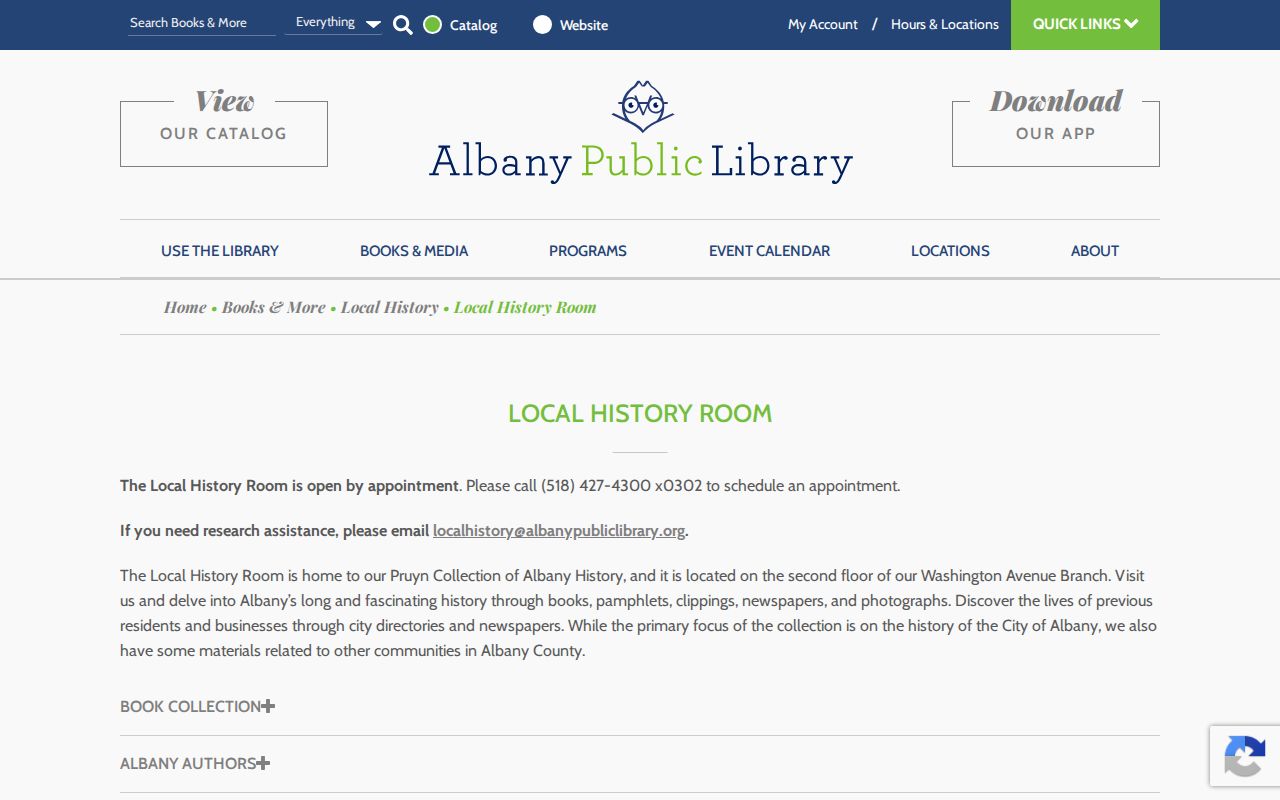
Printed, microfilm, digitized, and archival access all matter. The library says some 1813 to 1950 volumes can be retrieved when the Local History Room is closed, while later material has its own branch access. A name found in an old directory becomes more useful when paired with its street, ward, occupation, and the volume year.
Historic Albany Resident Directories
Albany's directory history is unusually deep. The library reports a nearly complete 1813-present run, while the Hall of Records lists city directories from 1830 to 1983 among its holdings. Street or House Guides are the reverse address layer in 1895, 1896, and 1914-present volumes. The business finder begins in 1857. Those distinct sections should be read together rather than treated as one uniform database.
For a full shelf-by-shelf explanation, see the Albany city directory collections. A directory entry can establish that a name was printed at a place in a specific year. It cannot prove uninterrupted residence, and an omission does not prove a person had left Albany.
Albany Archive Access Choices
The Hall of Records gives Albany research a long physical trail. Its Public Grantor/Grantee Index runs from 1630 to 1940, with old deeds, assessments, voter volumes, census material, maps, and finding aids available through the archive. On-site copies are 50 cents per page and written certification is $4. Its staff research form is a separate service at $20 per hour with a one-hour prepaid minimum, even if no record is found.
The Hall began as a joint city and county archive in 1982 and current county material describes more than 120,000 cubic feet of inactive and archival records. That scale explains why an online result is often a first pointer, not the final source. The county's 2024-2028 grant and 2025 scanning work may expand online coverage, but they do not make every historical deed book available now.
For a request, name the person or property, known spellings, a time range, municipality, and record type. The Hall form supports property, naturalization, census, marriage, and other requests. A Freedom of Information Law request can seek existing non-exempt agency records that are reasonably described, but FOIL does not require an office to create a new list or perform open-ended research. Albany County Clerk land and court fees are separate from ordinary FOIL copy rules.
The practical offline sequence is specific. The County Clerk search room can reach older land and court material after files are ordered ahead, and mail requests need the required payment and details. The Hall offers public research on site as well as its staff form. Albany Public Library can supply directory, newspaper, map, and yearbook context. The New York State Library and State Archives add statewide catalog, film, and index routes. Use the institution that owns the record rather than sending one broad request to every office.
Albany Address Privacy Limits
Public records should be used for lawful personal research, family history, estate questions, civic verification, and correcting a record. They do not open every address. Unlisted household members, utility customers, delivery records, and DMV data are not a general public residents directory. A parcel owner can be an entity, trustee, or person receiving tax mail somewhere else.
Lawful use. Albany address and record sources must never be used to stalk, harass, intimidate, or harm a person. New York's address-confidentiality and confidential-voter programs intentionally keep protected locations out of ordinary public results.
The New York Address Confidentiality Program uses a substitute Albany mailing address for eligible participants, while confidential voter registration can protect a record for four years. A missing result may be a lawful privacy protection, not a gap to defeat.
When an official source is wrong, return to the office that keeps that record. Court information is corrected by the court, city permit material has a dispute process, and vital records use their own amendment procedure. A commercial people-finder category can mix stale or same-name material, so it should never replace the original Albany custodian.