
Albany City Directory Collections
Albany Public Library maintains a nearly complete run of Albany City Directories from 1813 to the present. The shelves, film, library databases, and archival holdings do not duplicate one another exactly, so the directory year matters. A reader can begin at the library, use an online page for a known year, or compare a library volume with the material at the Hall of Records and the New York State Library. The table identifies the major routes without assigning publishers that the local guides do not name consistently.
| Collection | Years | Where Held | Access |
|---|---|---|---|
| Albany City Directories | 1813-present, nearly complete | APL Pruyn Collection, NYS Library, Hall of Records | Print, film, and selected digital copies |
| Street and House Guides | 1895, 1896, 1914-present | Directory volumes and Hall guide | Street, then number, then occupant |
| Business Finder | 1857-present | Albany directory volumes | Business, profession, institution, or occupation |
| Digitized and library database copies | 86 free directory years; 1861-1960 except 1922 on Ancestry Library Edition | Digital Libraries & Archives, APL, NYS Library | Volume-by-volume searching and page downloads |
APL lists microfilm-room print volumes for 1950-1979, 1981, 1983, 1985-1986, 1988-1994, and 1996-2014. Other 1813-present volumes are in the Local History Room. The guide does not support a claim that every year or volume is identical, so check the catalog and the title page for the exact edition and imprint.
Albany City Directory at Pruyn
The Albany Public Library Local History Room is the practical starting place for printed directory research. It is on the second floor of the Washington Avenue Branch. The Pruyn Collection has more than 6,000 non-circulating Albany-history books, along with pamphlets, clippings, newspapers, photographs, directories, maps, and ephemera. The library lists appointment help at (518) 427-4300 ext. 0302 and localhistory@albanypubliclibrary.org. Its general local-history guidance also gives Tuesday evening access, so confirm hours before a visit.
If the room is closed, the library says directories from 1813 through 1950 can be retrieved. Volumes from 1950 forward can be requested or used at the Washington Avenue Branch when it is open. APL also holds some directories for Troy, Schenectady, Guilderland, Colonie, Bethlehem, and other suburbs. That nearby coverage can help when an Albany household appears to leave the city directory but remains elsewhere in the county.
Albany City Directories Online
APL's directory guide identifies 86 freely available digitized Albany years. Individual pages may be downloaded, and a complete PDF is available where the catalog marks it EBOOK-FREE. Digital Libraries & Archives searches individual volumes rather than providing one easy search across the whole run. Its advanced search can limit the City Directory (NEHGS) collection to Albany, New York. Ancestry Library Edition supplies a separate route for 1861-1960, except 1922, at APL public computers or Wi-Fi and at the New York State Library. It permits exact publication-title searching and uses Keyword for an address.
The American Ancestors image for the 1813 Albany directory shows why an original page should be checked beside its transcription.
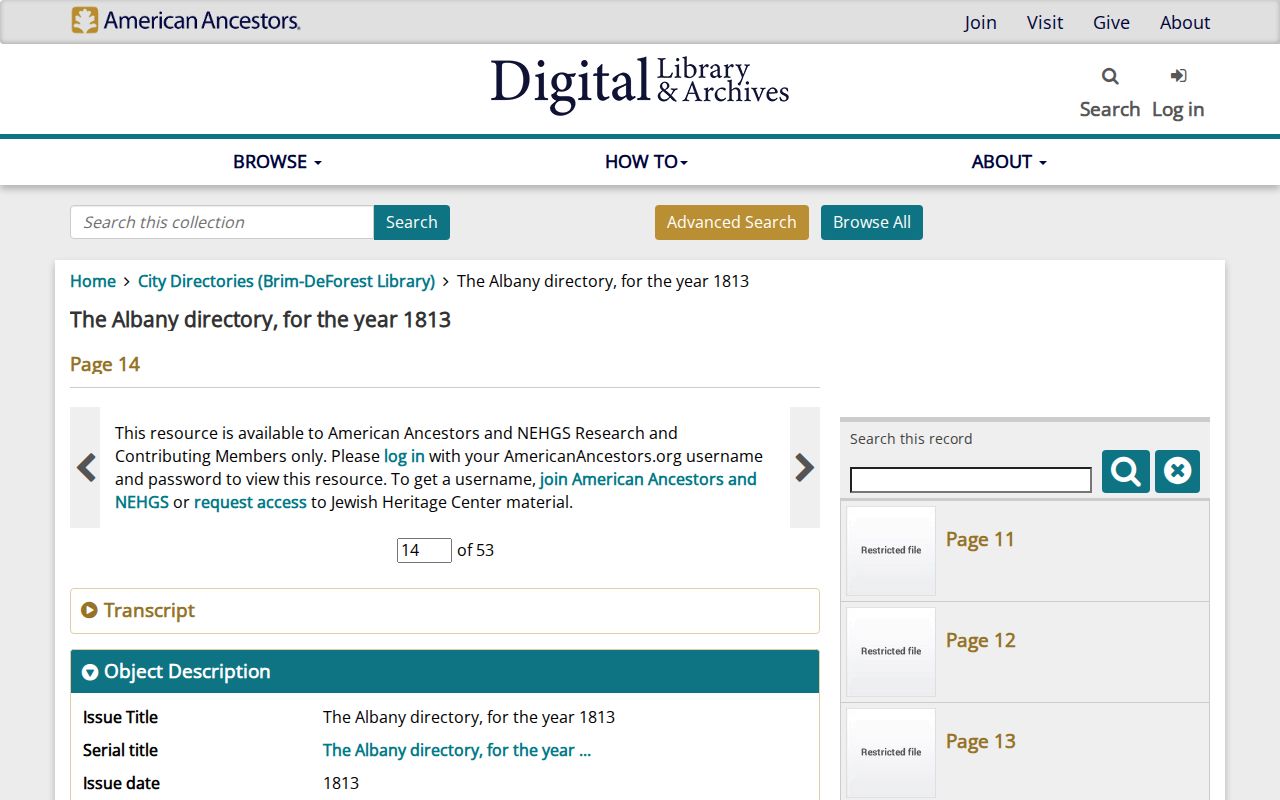
That page has a title, page identifier, image, and searchable transcript. Visible entries combine a surname and given name with an occupation or status and a residence address, sometimes adding a store or shop address. OCR and old spelling can be wrong, so the page image is the record to compare against the transcript.
Albany City Directory Numbers
The run begins in 1813 and remains nearly continuous at APL, a span of more than two centuries. Hall of Records finding aids separately list Albany city directories for 1830-1983. The dates explain why no single service is the whole answer. A researcher may move from a digitized early page to a library film reel, a current database copy, or an archival volume as the year changes.
| 1813 | Earliest Albany directory year in APL's nearly complete run and the digitized American Ancestors example. |
|---|---|
| 1830-1983 | Albany city directory range listed in Hall of Records finding aids. |
| 1857-present | Business Finder coverage in the directory volumes. |
| 1895, 1896, 1914-present | Street and House Guide anchor years for address-to-occupant work. |
Publishers changed by volume, and the inspected guides do not consistently name the imprint for each year. Read the title page before recording a publisher in notes or a citation. The dated range is useful, but it does not prove that an absent name was absent from Albany for an entire year.
Reading an Albany City Directory
An Albany city directory entry should be copied as it appears, including punctuation and abbreviations. The 1813 example shows names, occupations or status words, residence addresses, and at times store or shop addresses. Later volumes may add a spouse in parentheses, a telephone number, an owner or occupant notation, a widow notation, or business context. The meaning of a mark can shift from one edition to another, so use the key printed in that volume instead of assuming a standard meaning.
| Name | Surname and given name, with status or a spouse in parentheses when printed. |
|---|---|
| Address | House number and street, plus the directory year, section, page, and ward for a reproducible note. |
| Occupation or business | Work description, institution, business, or store address when the volume prints it. |
| Owner or occupant notation | A symbol or word used in that particular volume. Read its abbreviation key first. |
| Widow or move notation | Status, relationship, or a move/death notice when listed, which can point to a second record. |
- Criss-cross section
- A reverse, street-order directory section. In Albany Street Guides it runs from street name to house number to occupant.
- Householder index
- An alphabetical listing used to start with a person or household name before checking an address section.
- Abbreviation key
- The legend at the top of the directory section. Photograph or transcribe it before interpreting short marks in an entry.
Albany Street Guides by Address
Albany's Street Guide or House Directory is the address-to-occupant layer. It survives for 1895, 1896, and 1914 through the present in the local directory record. It is arranged alphabetically by street, then by house number, and it can list occupants of buildings and note a vacant address when applicable. It is not present in every directory year. The Hall guide recommends using 1895 to trace names backward, 1896 to trace them forward, and 1915 backward, then using the 1914-present run for later occupants and occupations.
After locating a name at an address, return to the alphabetical section for that person. This may recover an occupation, business context, or a second address. The Business Finder, available from 1857 forward, is arranged by business type, profession, institution, and occupation. It is a cross-check, not a complete roster: the Hall guide warns that not every business appears there, so the main resident section still needs a search.
Albany Directory Companions at Hall
The Hall of Records Inside/Outside guide places directory entries beside other local evidence. Hall holds assessment rolls from 1813-1976, voters, census volumes, deeds, permits, maps, and city directories. An assessment can supply a ward, lot, owner, or building description. Historical voter volumes are organized by ward, election district, street, and address, while a map can resolve an old street name or changed ward.
Newspapers and school material give useful context after the address is pinned down. APL has a complete Times Union run on microfilm and more than a dozen Albany newspapers. Prints from the microfilm readers cost 10 cents per page, and one reader can save JPG, TIF, or PDF files. Its clipping files cover thousands of local articles from the 1920s through the 1980s. Hundreds of print and digital yearbooks can help verify a school connection, age, or name variation without treating a directory listing as the only proof.
Albany Family Papers and Directories
The Albany County Historical Association collection on New York Heritage adds family-supplied context to an address or surname found in a directory. It represents only part of the association's manuscript and museum archives. The digitized material spans the seventeenth through twenty-first centuries and includes family papers gathered through community scanning events. It is not a public member directory and does not offer one uniform name index.
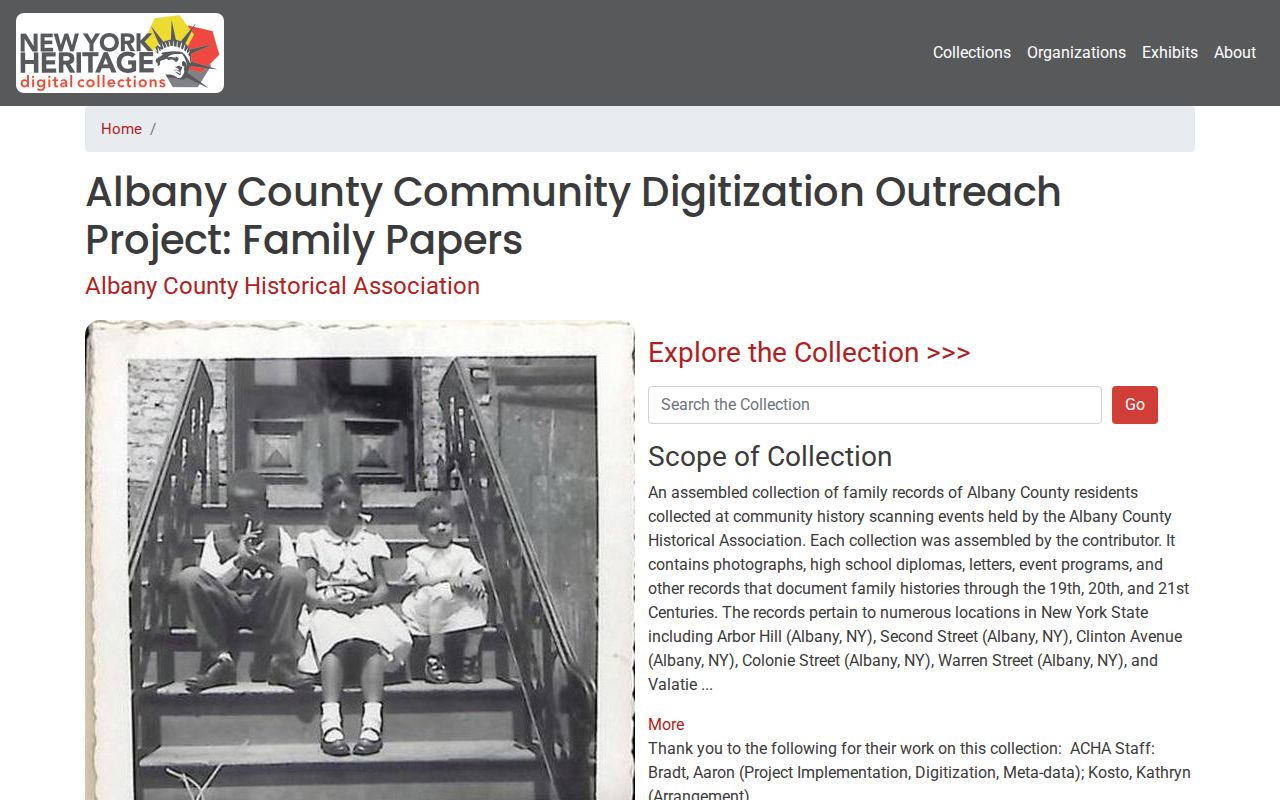
The collection can add photographs, correspondence, or local memory after a city directory establishes a name and place. Preserve the collection's provenance and treat it as historical context, not as a substitute for the printed directory or an official record.
Trace Albany City Directory Households
A household trail is strongest when each entry is tied to its year and then paired with a census or archive record. Federal census material is publicly available through 1950 under the National Archives 72-year rule. Hall lists New York State census holdings for 1855, 1865, 1875, 1892, 1905, 1915, and 1925, plus several federal census years. Directory entries fill the years between those snapshots, but a listing is evidence of the book entry, not continuous residence for every household member.
- Find the earliest Albany directory entry for the name, then copy the page, year, street spelling, address, and every abbreviation.
- Follow the name forward one available year at a time. Record each address, business wording, spouse or status phrase, and any change in spelling.
- Use the Street Guide for the same address where its year exists, then look up each listed occupant in the alphabetical section.
- Pair the directory sequence with the closest federal or New York State census. Compare the household, ward or municipality, and address rather than relying on a name alone.
- When a listing ends, check a newspaper, obituary, map, voter volume, assessment, or a neighboring municipality's directory before deciding whether the person moved or died.
Street names and city boundaries changed over time. Hall documents many former street names and shifting wards, while Albany annexations changed the municipal custodian in several periods. Keep a separate note for the historic street spelling and municipality. That small step prevents a plausible directory match from being attached to the wrong modern address.